
.png)
Smiles all round? The takeaways from the Trump – Xi meeting
- SEC Newgate
- May 19
- 3 min read
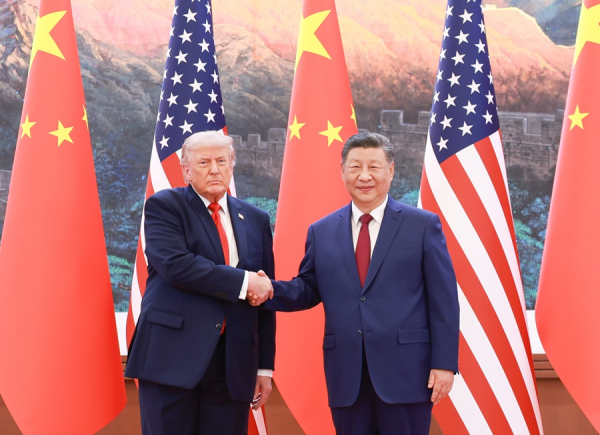
President Donald Trump's two-day state visit to Beijing on 14 and 15 May was the first by a sitting US president in nearly nine years. Ahead of the visit, expectations of significant progress was limited, with neither side signalling any appetite or having political headroom for reconciliation on the most contentious issues between the two countries.
Pomp and circumstance
While concrete commitments were limited, the visit was all about the choreography. Flag-waving schoolchildren and a brass band at the airport, a political and business star-studded dinner at the Great Hall of the People, a private tour of the Temple of Heaven, and a closing walk through Zhongnanhai, the walled compound for China's senior leadership.
Essentially, the focus was not substance but optics. From that perspective, the trip arguably exceeded expectations. There were no hiccups, no loose remarks, and, as a baseline for future meetings, it provided a new framework for the US – China relationship.
What has been agreed
Prior to the White House issuing a fact sheet of the outcomes on 17 May, Trump had described the trip as "historic" and "incredible," emphasising the "major" trade agreements made. The official US fact sheet confirmed a relatively narrow set of commitments from China:
An “initial” purchase of 200 Boeing aircraft, the first since 2017.
A commitment to purchase at least $17 billion per year of US agricultural products from 2026 to 2028, in addition to existing commitments on soybeans.
Restored market access for US beef and certain poultry exports.
Unlike the Chinese side, the US readout stated China would "address" concerns on supply chain shortages for rare earths and critical minerals, as well as on restrictions affecting the sale of related production and processing equipment. There were no details on how these concerns would be addressed.
While media reports during the visit highlighted a potential easing of restrictions on Nvidia H200 chip sales to China, no mention was made in the US fact sheet. It remains unconfirmed at the time of writing.
Looking outwards, the US readout covered several international issues, stating that both sides:
"Agreed" Iran cannot possess a nuclear weapon.
"Called" for the reopening of the Strait of Hormuz.
"Confirmed" a shared goal of denuclearising North Korea.
“Agreed” that no country or organisation should be permitted to charge tolls on international shipping lanes.
On Taiwan, the US statement was silent. Trump essentially skirted the issue both during the visit and in his subsequent remarks, telling Fox News that Taiwan was the "most important" issue for Xi, and that he would like the situation to "stay the way it is."
From Beijing's perspective, Xi's framing of Taiwan as a core issue of sovereignty was central. During the visit, Xi warned that mishandling the Taiwan question could put US – China relations in "great jeopardy."
Diplomatically, Chinese media also emphasised the new overarching principle for US – China relations, defined as a "Constructive Strategic Stability Relationship." Notably, the US fact sheet adopted similar language, while adding the qualifier that the relationship should be built "on the basis of fairness and reciprocity."
To help implement that principle, two new bilateral mechanisms for dialogue will be created:
A US – China Board of Trade, which will manage bilateral trade in non-sensitive goods.
A US – China Board of Investment, which will provide a forum for investment issues.
The official Chinese statement from the Ministry of Commerce also focused on bilateral agricultural trade, noting there would be "mutual tariff reductions on a defined range of products," highlighting seafood, poultry, and dairy exports from China to the US.
What comes next
In theory, Trump and Xi could meet up to three more times before the end of the year:
Xi has accepted a state visit to the US, currently scheduled for 24 September.
The APEC Summit in Shenzhen in November provides a second potential meeting point.
The G20 Summit at Trump National Doral in Miami in December offers a third.
Each of these events provides further opportunity for the two leaders to develop what both sides clearly wish to present as a stabilising personal relationship. Whether that translates into resolution of the more difficult underlying issues remains the open question.
Comments